Why Every Enterprise GPU Needs a Verifiable Lifecycle History
As GPUs become high-value enterprise assets, organizations need more than specifications and inventory records. They need a trusted history of what happened throughout an asset's lifecycle.
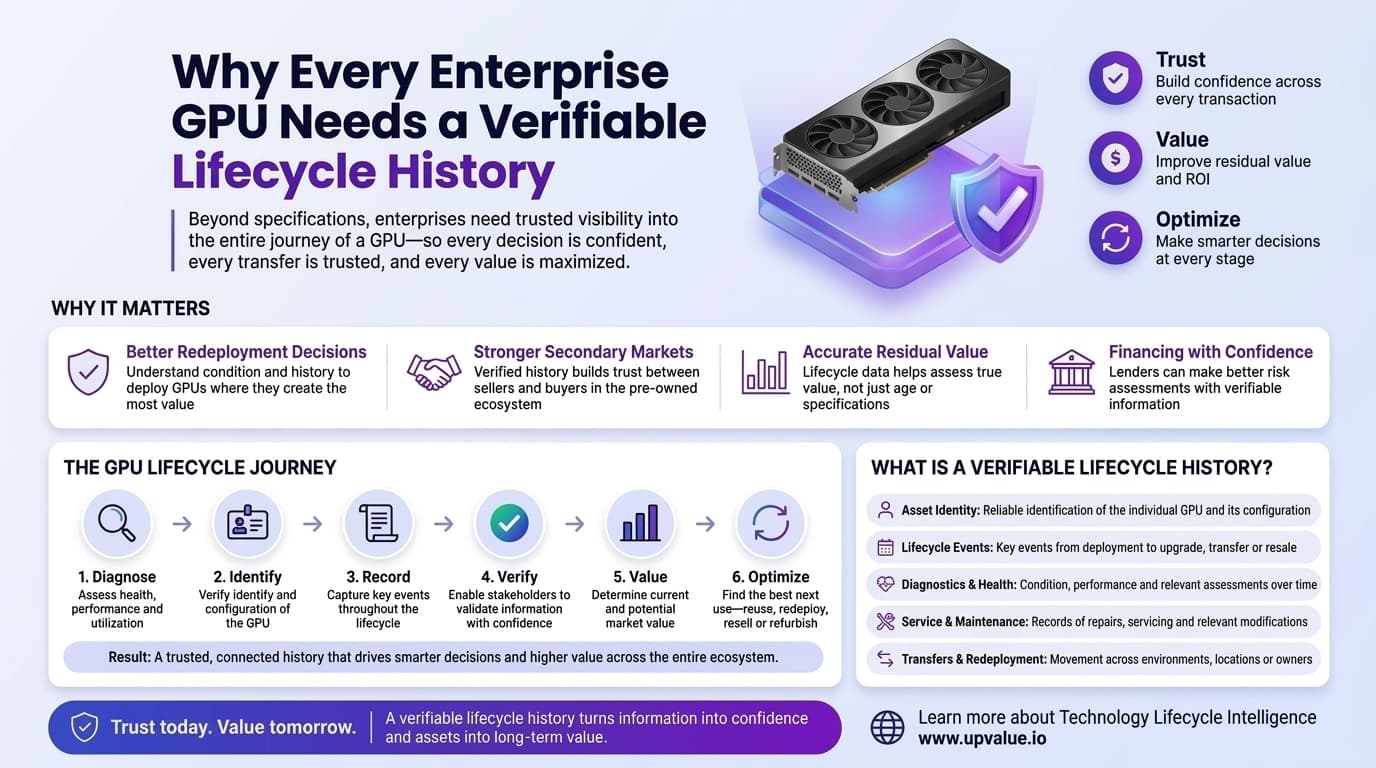
As GPUs become high-value enterprise assets, organizations need more than specifications and inventory records. They need a trusted history of what happened throughout an asset's lifecycle.
AI infrastructure is becoming one of the most valuable technology investments made by enterprises.
Organizations are acquiring GPUs and building infrastructure to support AI training, inference, and increasingly demanding workloads. But while significant attention is given to procurement, deployment, and compute capacity, a less visible challenge emerges once hardware enters the ecosystem:
A GPU may operate for years. It may move between systems, data centers, workloads, or owners. It may be upgraded, serviced, redeployed, resold, or used as part of a financing or buyback arrangement.
At each stage, new information is created. The problem is that this information does not always stay connected to the asset. That creates a lifecycle gap.
A GPU is more than a specification
When evaluating a GPU, it is easy to focus on static parameters:
- Model
- Memory
- Performance specifications
- Age
But specifications alone do not tell the complete story. Two GPUs of the same model may have had very different journeys.
One may have operated continuously under demanding workloads. Another may have experienced lighter utilization. One may have been serviced or repaired. Another may have changed ownership or deployment environments.
These lifecycle events can matter when organizations need to make decisions about:
Key Enterprise GPU Lifecycle Decisions
- Continued operation in existing compute clusters
- Redeployment across internal workloads or tiers
- Resale into secondary enterprise markets
- Buyback and structured trade-in programmes
- Financing and equipment collateral underwriting
- Residual value assessment and capital recovery
What is a verifiable lifecycle history?
A verifiable lifecycle history is a structured and trustworthy record of relevant events associated with an asset throughout its lifecycle. Depending on the environment and use case, this could include:
Core Components of a Verifiable Lifecycle History
Asset identity
A reliable way to identify the individual hardware asset and its relevant configuration.
Lifecycle events
Records of significant events throughout the asset's journey, from deployment to upgrade, transfer, or resale.
Diagnostics and health assessments
Relevant information about the condition and performance of the asset at different points in time.
Service and maintenance
Where applicable, records of repairs, servicing, or relevant modifications.
Transfers and redeployment
Records of movement between deployments, locations, or owners where relevant.
The objective is not necessarily to record every activity. It is to maintain a trustworthy record of the events that matter for future lifecycle decisions.
Why verification matters
1. Better redeployment decisions
When a GPU reaches the end of one deployment, an organization needs to determine what should happen next:
- Can it continue operating?
- Is it suitable for a different workload?
- Should it be redeployed internally?
- Should it enter a secondary market?
These decisions are stronger when they are based on reliable diagnostics and lifecycle information rather than assumptions. A verifiable history helps the next decision-maker understand the asset with greater confidence.
2. Greater confidence in secondary markets
Secondary markets depend on trust in the asset. A potential buyer may want confidence in:
- What the GPU is
- Its configuration
- Its condition
- Relevant service history
- Relevant lifecycle information
The less information available, the harder it can be to evaluate an asset. A better lifecycle history can help reduce information gaps between the current owner and the next stakeholder.
3. Residual value becomes easier to assess
The residual value of a GPU is influenced by more than its original purchase price. Condition, market demand, configuration, and lifecycle information can all be relevant.
A more complete understanding of an asset may help organizations make better decisions about:
- When to upgrade
- Whether to redeploy
- Whether to sell
- Potential buyback value
This is particularly important as GPU infrastructure becomes a larger capital investment.
4. Financing requires confidence
As AI infrastructure investments grow, financing models may play an increasingly important role. For a financing partner, understanding an asset can matter throughout the financing lifecycle. Questions may include:
- Can the asset be reliably identified?
- Can its condition be assessed?
- Can relevant lifecycle events be verified?
- Can its potential residual value be better understood?
Reliable lifecycle information does not eliminate risk. But it can help reduce uncertainty. And reducing uncertainty can support more informed financial decisions.
The trust problem grows as assets move
When an organization owns, deploys, and manages a GPU internally, much of its lifecycle information may remain within that organization. The challenge becomes greater when the asset moves.
- Enterprise A
- Transfer
- Data Center B
- Upgrade
- Redeployment
- Resale
- Enterprise C
At every transition, there is potential for information to become fragmented. The new stakeholder may not have access to:
- Original deployment information
- Diagnostics
- Service records
- Relevant ownership history
From asset tracking to lifecycle intelligence
Traditional asset tracking helps answer a single static question: What assets do we own?
Technology Lifecycle Intelligence goes further:
- What is this asset?
- What condition is it in?
- What has happened to it?
- What is it worth?
- What should happen next?
This represents a shift from simply recording assets to creating intelligence around their lifecycle. For GPUs and other high-value enterprise hardware, this could become increasingly important.
What should a trusted GPU lifecycle look like?
We believe a strong GPU lifecycle framework should connect six integrated stages:
- Diagnose
- Identify
- Record
- Verify
- Value
- Optimize
1. Diagnose
Understand the current condition, performance, utilization, and relevant health of the asset.
2. Identify
Establish confidence in the identity and hardware configuration of the individual GPU.
3. Record
Maintain an auditable record of relevant lifecycle events throughout the asset's journey.
4. Verify
Enable stakeholders to validate relevant asset and lifecycle information with confidence.
5. Value
Support more informed decisions about current residual and potential market value.
6. Optimize
Determine the best next use for the asset—whether reuse, redeployment, resale, or refurbishment.
The result is not just better asset management. It is potentially a more trusted technology ecosystem.
The opportunity for enterprises and ecosystem partners
A verifiable lifecycle history could create value across multiple stakeholders:
Enterprises
Better visibility when making upgrade and internal redeployment decisions across compute clusters.
Data centers
Greater confidence when managing, operating, and transferring high-value infrastructure.
Distributors and resellers
More verifiable information to support transparent secondary-market transactions.
Financing partners
Greater visibility into relevant asset information, condition, and lifecycle history.
Refurbishment partners
Better diagnostic and service information when assessing assets for reuse and recertification.
The important point is that lifecycle information can become even more valuable when assets move beyond a single organization.
Building trust into the technology lifecycle
Trust should not be something added only when a GPU is sold. It should be built throughout its lifecycle.
- Diagnostics performed today may help inform a deployment or valuation decision years later.
- A recorded service event may be relevant to a future secondary buyer.
- A verified transfer may help establish confidence during resale or financing.
The Upvalue perspective
At Upvalue, we believe high-value technology assets need better lifecycle intelligence. For enterprise GPUs, this means exploring how diagnostics, asset identity, lifecycle events, ownership information, and value intelligence can work together.
- Understand
- Verify
- Value
- Optimize
As AI infrastructure continues to scale, the conversation will naturally move beyond procurement. Organizations will increasingly need to understand what happens to infrastructure throughout its life—and what happens when that infrastructure moves to its next deployment, owner, or financial model.
Conclusion: Every asset has a story
A GPU has a lifecycle. It has a deployment history. It has a condition. It may have service events. It may have changed environments or ownership. And eventually, someone will need to decide what happens next.
The better that story can be understood and verified, the more confidently organizations can make lifecycle decisions.
The future of AI infrastructure is not only about deploying more GPUs. It is also about building greater trust in the GPUs already in the ecosystem.