Introducing Technology Lifecycle Intelligence: Smarter Decisions at Every Stage of the Asset Lifecycle
Technology assets should not be treated as disposable products. Discover how Technology Lifecycle Intelligence helps organizations diagnose, verify, value, and optimize assets across their full lifecycle.
Technology assets should not be treated as disposable products or one-time purchases. They should be understood, verified, valued, and optimized throughout their lifecycle.
Technology has a lifecycle. We need better intelligence to manage it.
For decades, the global technology industry has operated on a predominantly linear model: buy, deploy, use, and replace.
- Buy
- Deploy
- Use
- Replace
Whether it is a consumer smartphone, an enterprise laptop, a data center server rack, or an AI-grade GPU cluster, the trajectory has followed the same script: a new asset is acquired, provisioned for a designated workload, operated for a predetermined depreciation window, and eventually discarded or retired to make room for something newer.
Yet replacement does not inherently signal the end of an asset's useful life. A smartphone being upgraded by a consumer still commands strong resale demand. A server phased out from primary latency-sensitive microservices can power batch processing, staging, or disaster recovery tiers. A high-performance GPU rotated out from a frontier AI model training cluster retains immense computational value in fine-tuning, inference, or developer testbeds.
The fundamental challenge is not whether residual value exists. The real question is: How do we know what should happen next?
To answer that question with precision, organizations need far more than a passive spreadsheet recording what technology they own. They need Technology Lifecycle Intelligence.
What is Technology Lifecycle Intelligence?
Technology Lifecycle Intelligence (TLI) is the discipline and infrastructure that enables organizations to understand, verify, value, and optimize technology assets continuously throughout their lifecycle.
It bridges the gap between disparate IT tools, operational telemetry, and secondary market mechanisms. Rather than assessing hardware only at the moment of initial procurement and eventual decommissioning, Technology Lifecycle Intelligence provides actionable insight across the entire operational lifespan.
At its foundation, Technology Lifecycle Intelligence answers four decisive questions whenever equipment is upgraded, transferred, financed, redeployed, or resold:
1. What condition is it in?
Accurate, objective diagnostics assessing functional health, component wear, battery or silicon degradation, and cosmetic integrity far beyond original surface specifications.
2. Can its identity and history be verified?
Verifiable provenance, serial authenticity, tamper-proof hardware configurations, past repair logs, and complete chain-of-custody documentation that any counterparty can trust.
3. What is it worth today?
Dynamic, real-time market valuation derived from multi-channel demand, physical condition, configuration tiers, and regional liquidity pools rather than arbitrary accounting depreciation.
4. What is the best next use for it?
Strategic decision intelligence that determines whether an asset should be retained in place, redeployed internally, refurbished, resold, or responsibly recycled.
The traditional technology lifecycle is incomplete
The legacy technology ecosystem was designed primarily to sell brand-new hardware. From OEM product launch cadences to distributor quotas and enterprise procurement workflows, incentives heavily favor the front of the funnel: new releases, immediate rollouts, and accelerated replacement cycles.
What happens to the billions of dollars of hardware already in circulation?
Whenever an organization undertakes a hardware refresh, operators and finance leaders must make high-stakes determinations:
- Should the existing asset continue in its current deployment?
- Can it be seamlessly redeployed to another subsidiary, department, or tier?
- Is the equipment economically suitable for component repair or refurbishment?
- What is its true liquid salvage or secondary market value today?
- Can its residual value be unlocked to substantially reduce the capital cost of the next upgrade?
- Can prospective downstream buyers, lessors, or audit teams trust its historical maintenance records?
Without reliable, shared intelligence, these determinations are made in silos. Diagnostic metrics remain isolated in testing tools; asset tags sit disconnected in ERP databases; ownership histories fail to travel with the physical equipment; and residual valuations are determined through subjective guesswork. As enterprise technology becomes more expensive and mobile, this fragmented approach drains capital, slows upgrades, and generates unnecessary waste.
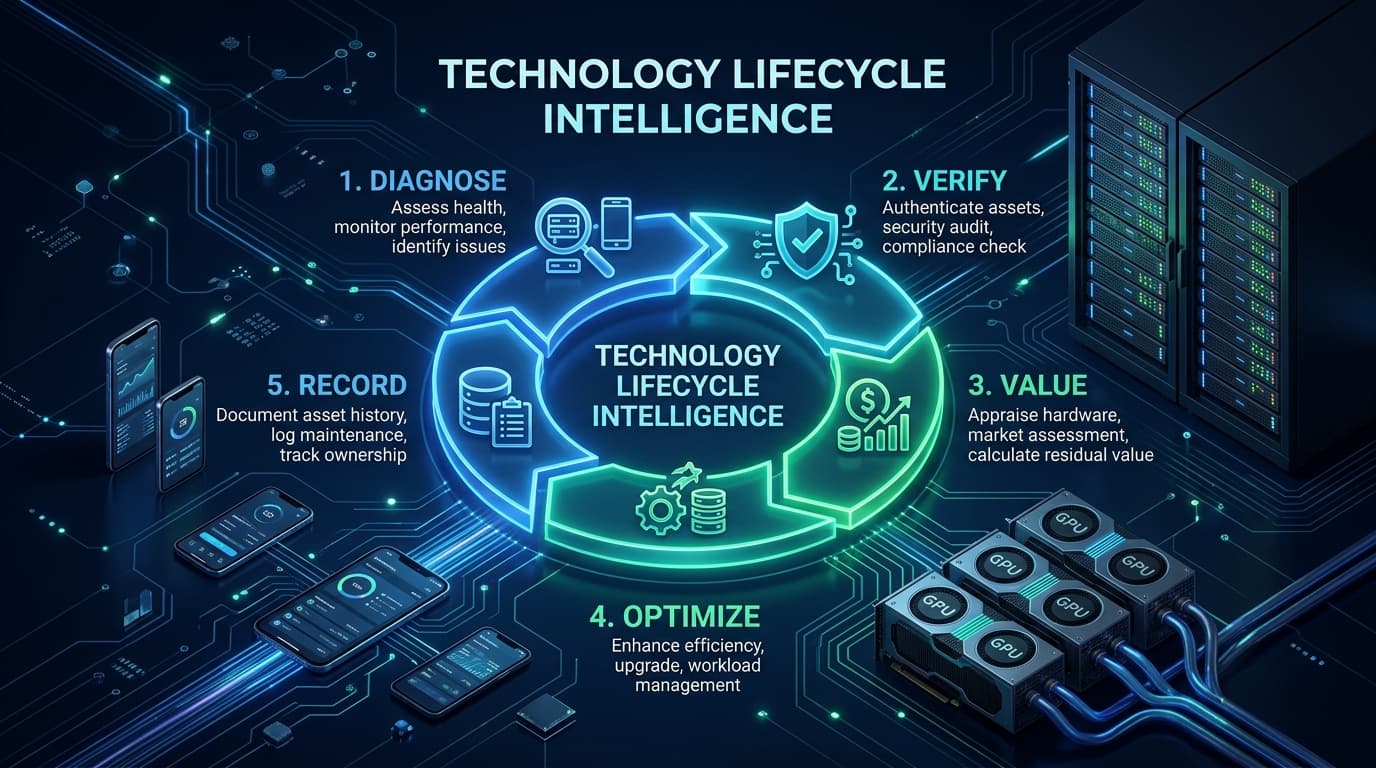
A better lifecycle model: Diagnose → Verify → Value → Optimize → Record
We believe technology assets must travel through an intelligent, connected lifecycle loop. In this model, every phase produces verifiable data that informs the subsequent decision:
- Diagnose
- Verify
- Value
- Optimize
- Record
1. Diagnose: Understand the actual condition of the asset
An asset's technical specification merely outlines what it was engineered to do on day one. Diagnostics reveal its actual, present-day condition.
This distinction is paramount. Two devices sharing the exact same model number and specification can exhibit vastly divergent operational states depending on their thermal exposure, utilization intensity, maintenance quality, and component wear.
Standardized, neutral diagnostics remove subjective bias, providing an empirical baseline for decisions around continued usage, component-level repair, field redeployment, or secondary remarketing.
2. Verify: Create confidence in the asset and its information
As devices change hands between departments, subsidiaries, trade-in operators, and secondary enterprise buyers, trust becomes the primary constraint on transaction speed and valuation.
Downstream partners, enterprise lessors, and secondary buyers require absolute confidence across five key dimensions:
- Asset Identity: Cryptographic and hardware-level validation verifying authentic serialization.
- Configuration: Verified audit of processors, memory, storage modules, and attached peripherals.
- Lifecycle Telemetry: Objective workload duration, duty cycles, and operating parameters.
- Chain of Custody: Transparent ownership logs eliminating grey-market or encumbered asset risks.
- Service History: Documented maintenance, authorized parts replacements, and certified data erasure.
Verification eliminates information asymmetry, establishing whether the data accompanying a piece of technology can be relied upon without expensive, redundant re-inspection.
3. Value: Understand what the asset is worth today
Technology assets do not lose value along an arbitrary straight-line accounting depreciation curve. Secondary market prices reflect fluctuating supply, international demand, component shortages, upcoming product releases, and exact physical condition.
Real-time value discovery unlocks the true residual equity trapped inside idle or depreciated hardware estates. It enables organizations to identify optimal liquidation windows, negotiate fair trade-in credits, structure asset-backed financing, and make upgrades far more cost-effective.
4. Optimize: Determine the best next use
The decommissioning of an asset from one deployment should never automatically mean obsolescence. Informed by rigorous diagnostics and residual value calculations, organizations can orchestrate the ideal next destination for each piece of equipment:
Strategic Asset Optimization Pathways
- Retain: Keep the hardware in its current deployment when performance metrics and reliability reliably satisfy operational requirements.
- Redeploy: Reassign assets internally to alternative teams, regional branch offices, or development sandboxes.
- Repurpose: Transition specialized equipment into broader roles, such as converting AI training GPUs into dedicated inference nodes or microservices.
- Refurbish: Replace consumable components (batteries, thermal paste, fans, drives) to restore assets to like-new operational reliability.
- Resell: Channel assets through multi-buyer marketplaces or trade-in programs to recover maximum market capital.
- Recycle Responsibly: Safely recover raw precious materials and dispose of hazardous components in strict compliance with environmental e-waste regulations.
The objective is not to extend the lifespan of every asset indefinitely at all costs. The goal is to make the most economically and operationally rational decision grounded in verifiable evidence.
5. Record: Build an auditable lifecycle history
Every key milestone in hardware life—from initial configuration and diagnostic health checks to repairs, ownership reassignments, and redeployments—contributes to its ongoing record.
Maintaining a centralized, auditable lifecycle record ensures end-to-end transparency across the entire technology ecosystem. A verifiable record eliminates counterparty hesitation, simplifies regulatory compliance, and boosts resale premiums.
Why Technology Lifecycle Intelligence matters
Technology Lifecycle Intelligence is not merely a tracking mechanism; it directly solves four macro challenges reshaping the global technology sector:
🌱 1. Sustainability & Circularity
Usable technology should never prematurely end up in landfills. By pairing condition diagnostics with next-use matching, organizations drastically extend useful life and contribute directly to a lower-carbon, circular technology economy.
💰 2. Affordability & Capital Efficiency
When organizations recognize and capture residual value from existing devices, that capital directly subsidizes the next generation of hardware upgrades, significantly lowering total cost of ownership (TCO).
📊 3. Better Value Discovery
The commercial value of hardware fluctuates across channels, regions, and buyers. Granular intelligence connects supply with optimal demand, avoiding fire-sale discounts and single-buyer lock-in.
🔍 4. Trust and Ecosystem Transparency
Verifiable diagnostic scores, genuine part confirmations, and immutable provenance give buyers, lenders, and secondary operators complete confidence to transact without friction.
From smartphones to AI infrastructure: A unified paradigm
Although smartphones and AI data center servers serve entirely different users, their underlying lifecycle dilemmas are identical.
📱 Smartphones & Connected Devices: In the consumer and retail world, a smartphone upgrade triggers an immediate recommerce event. The customer’s existing device can be traded in, refurbished, resold, or redeployed. This is where Smartphone Orchestration becomes vital—connecting diagnostic grading, pricing algorithms, multi-buyer bidding, and retail POS systems into frictionless upgrade journeys that maximize value recovery for consumers, retailers, and telco carriers.
🖥️ GPUs & AI Compute Infrastructure: In enterprise data centers, the generative AI boom has driven unprecedented capital expenditure into high-performance GPUs and server nodes. Yet these high-value compute clusters face severe thermal stress, rapid generational obsolescence, and complex ownership models. As we explored in our analysis of why AI infrastructure needs lifecycle management, organizations require GPU Lifecycle Management to verify silicon health, track operational hours, determine residual compute pricing, and facilitate secondary cluster redeployment.
Moving beyond the linear economy: The Upvalue vision
The linear model of 'Buy → Deploy → Use → Replace' is obsolete. As hardware becomes more technologically sophisticated, capital intensive, and constrained by global supply chains, the technology ecosystem must manage what already exists with the same sophistication it applies to buying new.
The greatest economic and ecological opportunity in technology over the coming decade lies in unlocking the latent value in devices already in circulation.
- Understand
- Verify
- Value
- Optimize
At Upvalue, our mission is to build the intelligence and orchestration infrastructure that powers this transition. By helping organizations understand, verify, value, and optimize their technology assets throughout their lifespan, we are turning fragmented lifecycle data into actionable intelligence—and building a more sustainable, affordable, and transparent technology economy.