AI Infrastructure Needs Lifecycle Management: The Next Challenge Beyond GPU Procurement
AI infrastructure investment is focused on acquiring GPUs and compute. But deployment is only the start of a GPU's lifecycle. Diagnostics, ownership history, residual value and redeployment are becoming central to managing it.
AI infrastructure investment is focused on acquiring GPUs and compute. But deployment is only the start of a GPU's lifecycle. Diagnostics, ownership history, residual value and redeployment are becoming central to managing it.
Capacity is the story today. Lifecycle is the story next.
AI is pulling enormous capital into GPUs, servers, networking and data centres. Spending that was once spread across a broad estate of general-purpose equipment is now concentrated in a narrow set of very high-value assets, deployed fast and at scale.
The current priorities are obvious: securing the right GPUs, getting compute capacity, deploying quickly, keeping utilisation high, and financing it all. When demand outpaces supply, capacity is the constraint that matters.
But as the first waves of deployed capacity begin to age, get upgraded or get reallocated, a second set of questions arrives:
- What condition is an asset in?
- Can its ownership and history be verified?
- What is it worth today?
- What is the best next use for it?
These are not disposal questions asked once at the end of life. They recur throughout it.
A GPU is infrastructure and a high-value asset
Both are true at once. A GPU is part of a cluster — provisioned, scheduled, measured by throughput. It is also a serialised asset with a market price, a condition, an owner and a history.
Most operational tooling treats it as the first. Most financial and lifecycle decisions depend on the second.
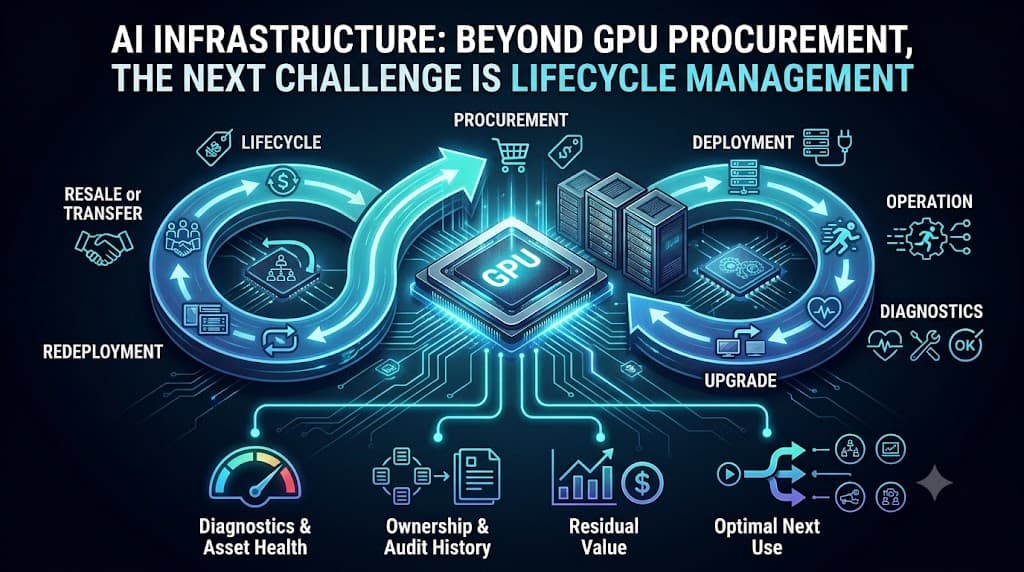
Over its life, an asset moves through procurement, deployment, operation, diagnostics, upgrade, redeployment, and eventually resale or transfer. At each stage the available information shapes the decision: has it been repaired, how has it been used, who has owned it, how much useful life remains, what is it worth.
Without structured lifecycle data, those answers live in scattered places — a spreadsheet, a monitoring dashboard, a vendor email thread, an engineer's memory of which chassis ran hot last year. Each answer exists somewhere, but not in a form that supports consistent decisions across thousands of assets, several hardware generations and multiple ownership arrangements.
The lifecycle gap
Procurement and deployment are mature, well-tooled disciplines. Lifecycle management is not.
Inventory systems record what you own; they don't assess condition or value. Monitoring systems watch live performance but rarely retain a durable, portable history of the asset itself. Procurement systems capture what was paid and stop there. The gap between them is where lifecycle decisions get made today — by judgement, under time pressure, with incomplete information.
Four questions every organisation should be able to answer
1. Diagnostics and asset health
Specifications don't describe condition. Two units with identical part numbers can have different thermal environments, duty cycles, error profiles and service events. The label is the same; the asset is not. When an asset is upgraded, redeployed, resold, bought back or financed, someone is pricing its condition — and if that assessment is informal, the uncertainty gets priced in as a discount, a contingency or a delay.
2. Ownership and audit history
High-value hardware changes hands. It may be owned by one party, financed by another, operated by a third, and moved between sites or organisations. An auditable record of identity, ownership, transfers, service events and deployment history reduces the diligence repeated at every handover. Within one organisation, institutional memory can partly substitute for records. Across organisations, it cannot.
3. Residual value
Depreciation schedules describe an accounting treatment, not what the market would pay today. Actual value moves with configuration, age, condition, performance, demand, availability and service history. Timing matters: the same asset sold two quarters apart can realise materially different amounts, and the gap is usually invisible because nobody tracks the number until they need it. Residual value already shapes financing and leasing in other capital-intensive industries; there's no obvious reason accelerated compute should be an exception.
4. Redeployment and reuse
The end of one deployment isn't the end of useful life. Hardware displaced from the most demanding tier is often displaced by capability, not failure — which means it may be entirely suitable elsewhere. Good lifecycle information is what lets an organisation choose between continuing, repurposing, refurbishing, reselling or transferring, rather than defaulting to whichever option takes the least effort.
From inventory to Technology Lifecycle Intelligence
Traditional asset management records what you own. That's a static register describing possession, not state.
Technology Lifecycle Intelligence is the ability to diagnose, verify, value, optimise and record technology assets throughout their lifecycle:
- Diagnose — condition from objective signals, not self-reported grades.
- Verify — identity and history a third party can rely on without redoing the work.
- Value — residual and market value informed by condition, not a depreciation schedule.
- Optimise — determine the most appropriate next use.
- Record — keep an auditable history, so each decision leaves evidence the next one can build on.
The payoff runs in four directions. Sustainability: most of a device's environmental footprint is embodied in manufacture, so keeping serviceable hardware in productive use is often the most material intervention available. Affordability: understanding value already held changes the true net cost of a refresh. Value discovery: it surfaces the difference between what one counterparty offers and what the wider market supports. Trust: it gives confidence to parties who never operated the asset themselves.
Why this becomes urgent later
Lifecycle questions arrive quietly. They aren't pressing in year one of a build-out — which is precisely why the systems to answer them don't get built. They become urgent at the first major refresh, by which point the information that would have made them answerable was never captured.
Building Technology Lifecycle Intelligence
At Upvalue, we're building solutions around Technology Lifecycle Intelligence — helping organisations understand, verify, value and optimise technology assets across their life. Our work spans Smartphone Orchestration, connecting diagnostics, value discovery and upgrade journeys, and GPU Lifecycle Management, exploring how enterprises and ecosystem partners build visibility around diagnostics, lifecycle information, ownership and asset value for AI infrastructure.
Conclusion: deployment is not the end of the story
Infrastructure doesn't stop being an asset once it's deployed. Four questions outlast the deployment: what condition is it in, can its history be trusted, what is it worth today, and what should happen to it next?
The future of AI infrastructure isn't only about acquiring more compute. It's about managing the compute we already have more intelligently.