Can We Trust the Asset? The Foundation of Technology Reuse, Resale, and Financing
Before technology can be reused, resold, or financed, one fundamental question needs to be answered: Can we trust the asset and the information associated with it? Discover why trust and lifecycle intelligence drive secondary market economics.
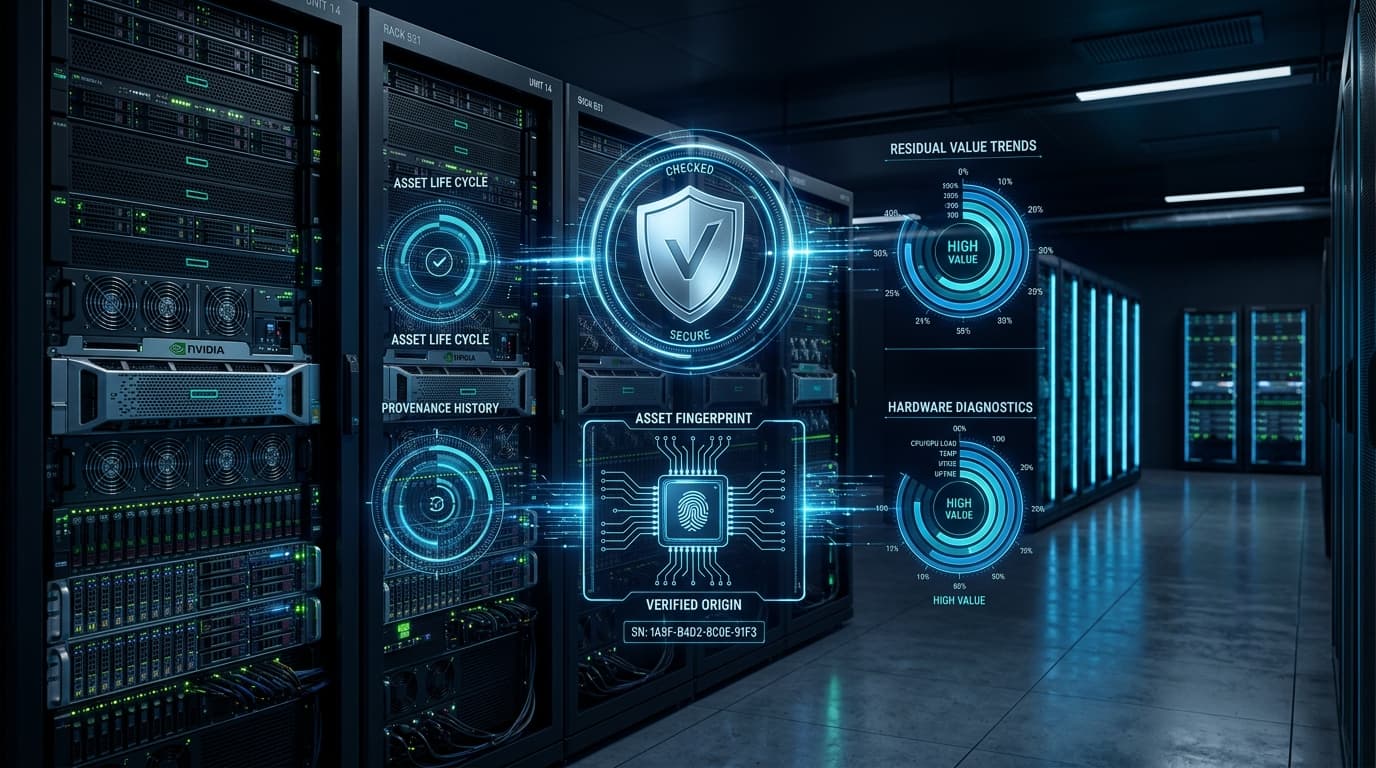
Before technology can be reused, resold, or financed, one fundamental question needs to be answered: Can we trust the asset and the information associated with it?
As technology assets move beyond their original deployment, they enter a far more complex and distributed ecosystem. A high-performance GPU cluster may move from one data center tier to another. Enterprise compute hardware may be redeployed for a completely different workload. A fleet of mobile devices or client laptops may be sold into the secondary recommerce market. And an asset may even be considered as collateral in a specialized equipment financing or buyback programme.
Yet whenever an asset changes hands, changes locations, or enters a new financial structure, a fundamental friction appears: the next stakeholder was not in the room when it was originally purchased, configured, or operated.
They did not observe its thermal stress history, its component replacements, its duty cycles, or its maintenance logs. Consequently, before any capital is committed or any deployment is approved, they need clear, indisputable answers.
The 5 Questions Every Stakeholder Must Answer
Whether you are a secondary market buyer, an IT operations lead evaluating internal redeployment, or a financial institution underwriting hardware leases, five decisive questions define the transaction:
1. Hardware Condition & Health
What is the actual condition of this hardware? Beyond cosmetic surface inspections, what does objective component telemetry, silicon health, battery degradation, and thermal performance reveal?
2. Ownership & Lifecycle History
Can its ownership and lifecycle history be verified? Is there an auditable, tamper-proof chain of custody tracking past operating environments, previous custodians, and transfer timestamps?
3. Maintenance & Modifications
Has it been repaired or modified? Have non-OEM parts been swapped in? Has the firmware been altered? Has the hardware underwent critical component servicing over its operational life?
4. Asset Identity & Configuration
Can we reliably identify the asset and its configuration? Can we independently verify the exact component specifications—serial numbers, memory tiering, accelerators, firmware revisions—without manual guesswork?
5. Confident Residual Value
Can we confidently determine its market value? Based on empirical condition, provenance, and active multi-channel demand, what is this asset genuinely worth today in the open market?
6. Counterparty Confidence
Can counterparties transact without friction? Without reliable, verifiable data, trust erodes—and when trust erodes, reuse, resale, and asset financing grind to a halt.
Trust Is Not Just a Compliance Issue: It Directly Dictates Economics
In enterprise technology management, trust is often mistakenly relegated to a legal compliance or procurement checkbox. But for high-value technology assets—from H100 GPU clusters and enterprise SAN arrays down to flagship smartphone fleets—trust directly drives the financial equation.
- Buyers hesitate or demand deep discounts: A secondary market purchaser faced with ambiguous operating logs or uncertain silicon degradation will either refuse the transaction or heavily discount their offer to protect against hidden risks.
- Financing partners pull back: A bank or leasing partner cannot structure asset-backed loans, buyback guarantees, or residual-value financing if they lack reliable data on the asset's verifiable identity, current state, and projected liquidity.
- Enterprises avoid redeployment: An IT organization may choose to warehouse or scrap perfectly viable servers because internal infrastructure teams cannot confidently guarantee that aging hardware won't cause catastrophic outages in production workloads.
When asset history is opaque, risk premiums soar. Sellers recover only a fraction of their residual value, buyers take on unknown failure liabilities, and usable silicon ends up stockpiled in storage closets or shredded prematurely.
What Creates Trust? The Four Foundational Pillars
Trust cannot be manufactured with marketing claims or subjective grading tiers. In complex technology ecosystems, trust must be engineered from objective data across four integrated pillars:
Accurate Diagnostics
Automated, neutral testing that probes actual functional performance, component stress tolerances, thermal telemetry, and hardware health—removing subjective bias from the inspection process.
Reliable Asset Identity
Cryptographic, hardware-level fingerprinting that confirms precisely what the asset is, its exact SKU, subsystem specifications, and component-level serializations across its entire chassis.
Auditable Lifecycle History
A permanent, chronological record tracking every milestone: procurement origin, workload allocations, firmware updates, maintenance interventions, diagnostic benchmarks, and chain-of-custody handoffs.
Transparent Value Discovery
Real-time, market-indexed valuation models that synthesize physical condition, verified provenance, and multi-buyer global demand into an accurate, actionable residual value.
- Neutral Diagnostics
- Hardware Fingerprint
- Auditable Provenance
- Residual Valuation
- Next Best Use
Together, these four capabilities turn technology assets from unverified black boxes into trusted, liquid instruments that can transition effortlessly across owners, workloads, and balance sheets.
The Opportunity for Modern Technology Ecosystems
The global technology landscape is undergoing an unprecedented shift. Driven by soaring capital expenditures, supply chain bottlenecks, and mandatory sustainability commitments, the industry is rapidly leaving behind the primitive "buy, use, and discard" model in favor of agile, multi-stage lifecycles.
Across enterprise IT, telecommunications, hyperscale cloud, and recommerce, high-growth ecosystems are emerging around:
Key Circular Ecosystem Models
- Enterprise Hardware Refurbishment: Restoring high-grade enterprise compute and enterprise networking to factory-spec operational readiness.
- Dynamic Secondary Markets: Active multi-buyer liquidity networks trading validated smartphones, laptops, and specialized server nodes.
- Internal Workload Redeployment: Cascading tier-1 compute and AI accelerators down to inference, development, batch processing, or disaster recovery clusters.
- Guaranteed Buyback Programmes: OEM and telco trade-in mechanisms providing guaranteed residual recovery for enterprise and retail customers.
- Asset-Backed Hardware Financing: Modern equipment leasing and credit lines secured by verified, observable hardware collateral.
- Circular Technology Frameworks: Verifiable ESG compliance workflows that maximize asset longevity and prevent premature e-waste.
Yet for any of these ecosystems to scale efficiently, every participant—from the initial enterprise owner to the refurbisher, the lender, and the ultimate secondary buyer—must possess unshakeable confidence in the assets moving through the pipeline.
That confidence requires comprehensive, verifiable information. Trust is not an afterthought to be bolted on at the end of an asset's lifecycle. It must be engineered directly into the lifecycle itself.
Building Trust with Technology Lifecycle Intelligence
At Upvalue, we believe neutral diagnostics, cryptographic asset identity, immutable lifecycle records, and real-time value intelligence must operate together as a cohesive infrastructure layer.
This is the core foundation of our vision for Technology Lifecycle Intelligence (TLI). By replacing fragmented spreadsheets and subjective inspections with automated diagnostic telemetry, verifiable provenance, and neutral multi-buyer price discovery, we empower organizations to unlock the full residual value of their technology estates.
Because before an enterprise server, an AI GPU cluster, or a fleet of smartphones can move confidently to its next deployment, its next owner, or its next financing model, the ecosystem must always be able to answer one simple, decisive question:
#TechnologyLifecycleIntelligence #AssetProvenance #GPULifecycle #CircularEconomy #TechnologyFinance