Technology Upgrades Are Expensive: But Are We Ignoring the Value We Already Have?
Whenever organizations upgrade technology, decisions usually focus on the price of the new asset. Discover why calculating Effective Upgrade Cost and unlocking residual value changes everything.
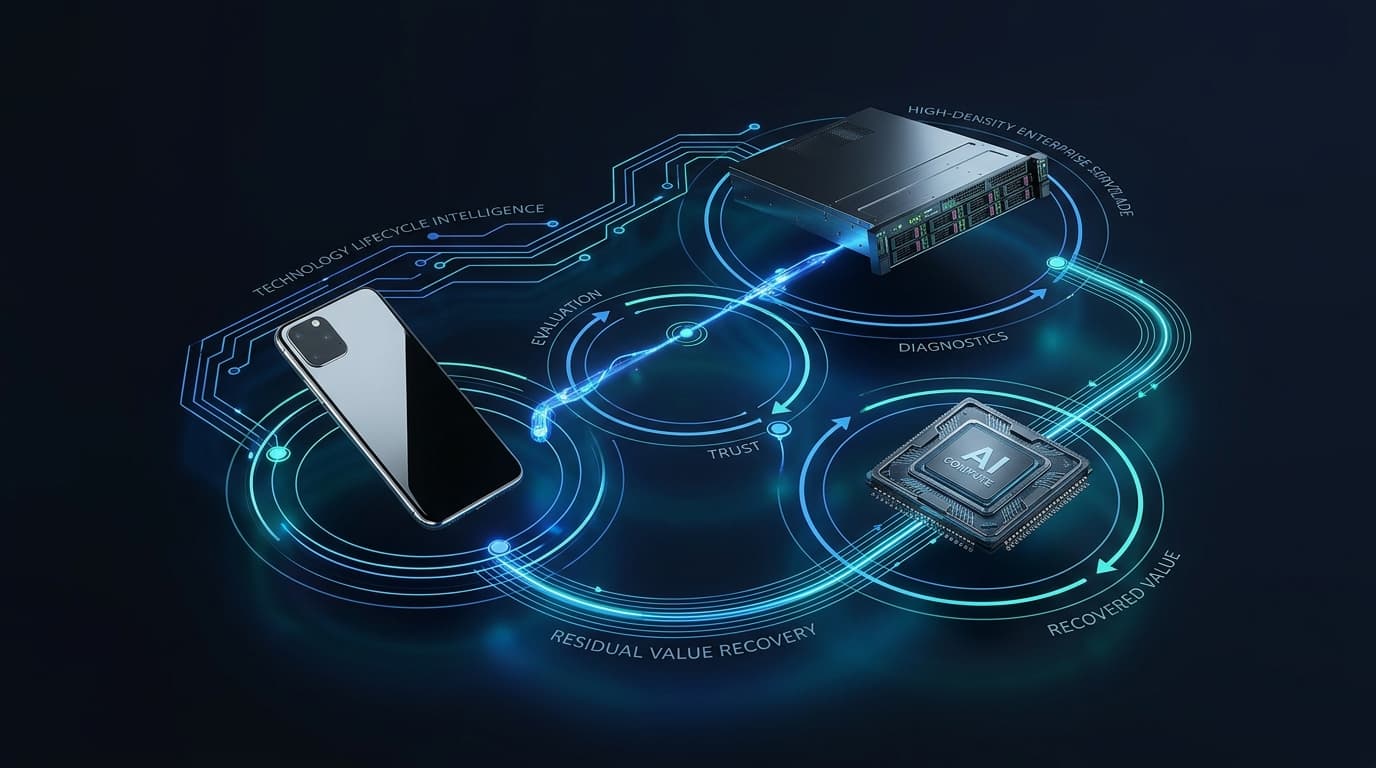
Technology upgrades are expensive. Whenever we think about upgrading technology, the conversation usually starts with the price of the new asset. But are we ignoring the value we already have?
Whether it is a consumer evaluating a new flagship smartphone, an enterprise IT leader provisioning a fleet of rackmount servers, or an AI infrastructure team securing the next cluster of high-performance GPUs, the question that dominates the room is almost always the same:
Yet there is another equally decisive question that is far too often ignored: What is the technology we already own worth today?
The upgrade equation that needs to change
In standard procurement and upgrade workflows, decisions are routinely treated as a one-way financial transaction:
This formulation assumes that existing assets have zero remaining commercial or operational value the moment a replacement is ordered. But replacement does not mean obsolescence. Across every tier of hardware, significant residual value is left on the table:
- Smartphones: A smartphone being upgraded may still retain hundreds of dollars in secondary market resale, trade-in, or refurbishing value.
- Enterprise Hardware: Enterprise servers being replaced during a compute refresh may still be perfectly viable for staging environments, secondary tiers, or branch office workloads.
- AI Compute & GPUs: A GPU that is no longer optimal for frontier model training may still have immense commercial value for inference workloads, fine-tuning tasks, or academic research clusters.
When organizations ignore what they already own, they artificially inflate their capital expenditures. We believe the equation should be:
The valuation challenge: What is existing technology actually worth?
The challenge, of course, is understanding what that existing value actually is. Technology does not lose value along an arbitrary straight-line accounting depreciation curve. Its true residual value depends on five dynamic, interconnected factors:
🔍 Condition and Diagnostics
Hardware health, silicon degradation, battery cycle wear, functional integrity, and cosmetic grading beyond original factory specs.
📜 Asset and Ownership History
Verifiable chain-of-custody, serial authenticity, tamper-proof maintenance logs, and certified data sanitization records.
📊 Current Market Demand
Real-time pricing fluctuations driven by secondary market appetite, channel demand, and global hardware availability.
🌍 Location and Available Buyers
Regional buyer liquidity, logistics networks, and access to competitive multi-buyer marketplaces rather than single-buyer lock-in.
🔄 Potential for Reuse or Redeployment
Internal redeployment feasibility, component harvesting, refurbishing yield, or secondary workload suitability.
Where Technology Lifecycle Intelligence makes the difference
This is where we believe [Technology Lifecycle Intelligence](/blog/technology-lifecycle-intelligence) can make a fundamental difference.
Rather than treating hardware as disposable line items, Technology Lifecycle Intelligence provides organizations with the continuous visibility required to answer four core questions before any upgrade decision is made:
- What do we have?
- What condition is it in?
- What is it worth?
- What is the best next use?
When teams have clear, empirical answers to these questions, they stop treating upgrades as blind capital expenditures. Instead, they can determine whether to retain, redeploy, refurbish, or monetize their existing assets.
The objective is not simply to sell old technology. It is to make sure that the value remaining in an existing asset is considered before buying the next one.
Building an affordable, sustainable, and efficient ecosystem
Shifting to an effective upgrade cost framework creates systemic benefits that ripple across the entire technology ecosystem:
Three Pillars of a Smarter Hardware Ecosystem
- 💰 Affordable Technology Ecosystem: By recovering and reinvesting the residual value trapped inside existing hardware, organizations significantly subsidize future upgrades and lower their total cost of ownership (TCO).
- 🌱 Sustainable Technology Ecosystem: Extending the operational lifespan of hardware and keeping functional assets out of landfills directly supports circular economy principles and curtails e-waste.
- 📊 Efficient Technology Ecosystem: Eliminating stranded hardware, idle server racks, and undervalued device inventories ensures maximum economic return on every technology asset acquired.
Connecting diagnostics, trust, and next-best-use decisions
At Upvalue, this is one of the core problems we are working on—connecting diagnostics, trust, value, and next-best-use decisions throughout the technology lifecycle.
From enabling Smartphone Orchestration that drives frictionless retail trade-in journeys, to providing GPU Lifecycle Management and AI Infrastructure Lifecycle Solutions, our goal is to turn fragmented hardware data into actionable intelligence.