The Trust Layer of the Technology Lifecycle
Why the future of technology reuse, resale, and financing depends on verifiable asset history. Discover how Technology Lifecycle Intelligence bridges the information gap.
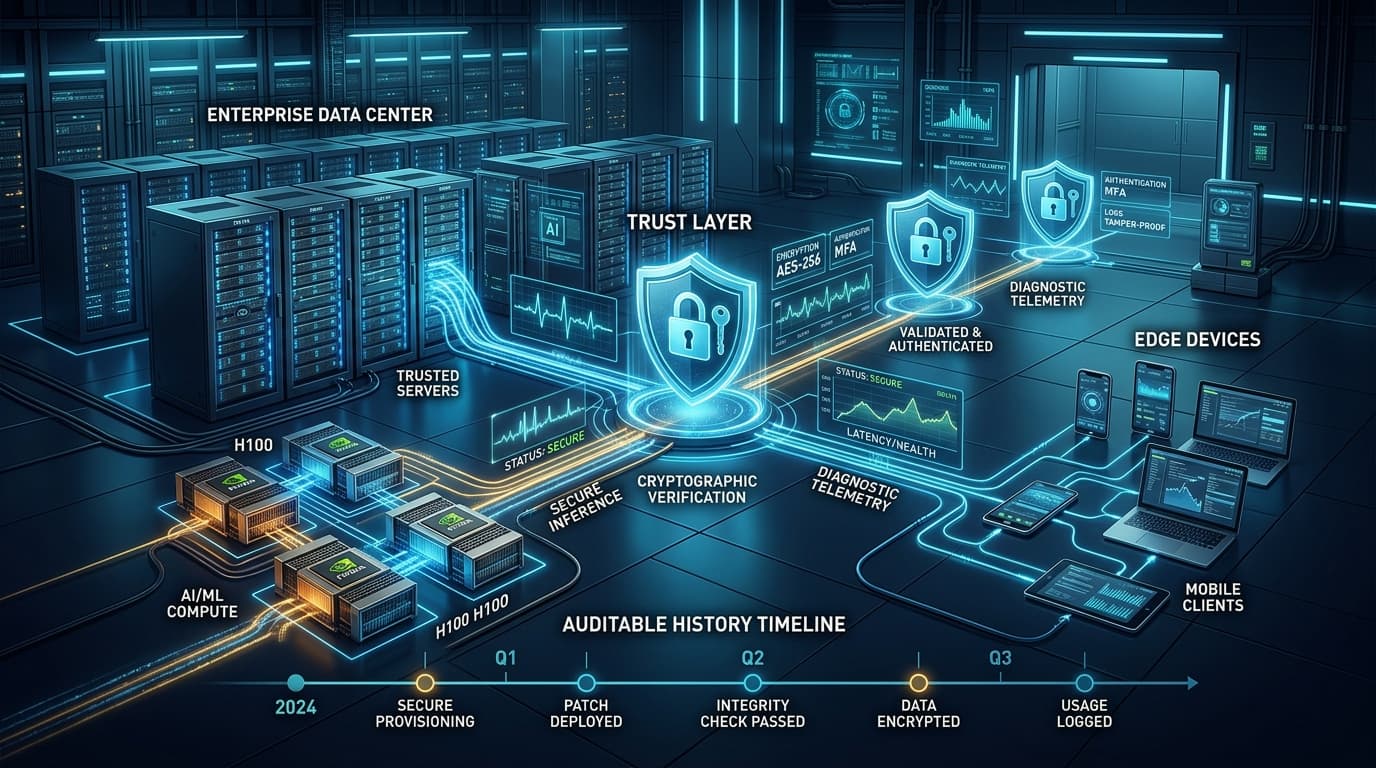
Technology assets are becoming more valuable, more complex, and more mobile. A smartphone moves from a consumer to a trade-in program, then to a buyer, then potentially to another user. A GPU moves from an AI workload to another data center, from an enterprise to a secondary market, or from one owner to another. A server can be redeployed, refurbished, financed, resold, or cannibalized for parts.
In each case, one question becomes increasingly important: Can we trust the asset?
Specifications Tell Us What an Asset Is. History Tells Us What It Has Been Through.
Consider two enterprise GPUs with the exact same model, configuration, and silicon specifications. On paper, they look identical.
Now imagine that one GPU has:
The Verified GPU Profile
- Verified Ownership History: An auditable, tamper-proof chain of legal custody and past operators.
- Documented Workload Exposure: Detailed telemetry tracking compute hours, duty cycles, and thermal envelopes.
- Recorded Maintenance: Timestamped logs of firmware updates, heatsink repasting, and fan module replacements.
- Verified Diagnostics: Objective hardware health scores and benchmark telemetry executed under neutral standards.
- Known Operating Condition: Empirical performance data under load, confirming zero silicon degradation.
- Complete Transfer History: Clear chronological lineage from initial deployment to current custody.
The other GPU has none of this information. Only a bare model sticker and a promise that it "worked when pulled from the rack."
Would a buyer value them equally? Would a financing company underwrite them equally? Would an enterprise infrastructure team be equally comfortable redeploying them into production workloads?
Probably not. The physical asset may be similar. The information surrounding the asset is not. And that information directly influences trust—and ultimately, economic value.
The Information Gap in Technology Markets
Traditional technology management has largely focused on the period when an asset is actively being used within a single enterprise boundary:
- We monitor uptime and server availability.
- We track compute and network performance.
- We manage scheduled maintenance and patches.
- We control security access and credentials.
- We depreciate the asset on fixed accounting schedules.
But when the asset approaches the end of its first use, that clean operational picture collapses. The information becomes fragmented across siloed databases, ticketing systems, and local spreadsheets.
Procurement vs. Real Value
We may know what we bought when the invoice cleared, but not necessarily what it is worth today in a dynamic secondary recommerce market.
Title vs. Operational History
We may know who owns it on paper, but not necessarily what happened to it during its operational lifecycle across datacenters and workloads.
Spec Sheet vs. Fitness for Next Life
We may know its technical specifications, but not necessarily whether it is suitable for another life without risking operational failure.
Trust Becomes Critical When Technology Changes Hands
The first owner may know the complete history of an asset because they operated it. The next buyer, redeployment team, or underwriter usually doesn't. That friction becomes acute in secondary technology markets.
Before transacting, any rational buyer or downstream operator demands answers to critical questions:
The 10 Questions Every Downstream Buyer Demands
- Is the asset genuine? Can hardware authenticity be validated at the silicon level?
- Is the reported configuration accurate? Does the physical hardware match the advertised specs and memory capacity?
- What condition is it actually in? Beyond cosmetic inspection, what is the internal component health?
- How heavily has it been used? What were its duty cycles, sustained operating temperatures, and workload intensities?
- Has it been repaired? Have internal components or micro-circuitry undergone previous servicing?
- What components have been replaced? Are replacement modules genuine OEM parts or third-party substitutes?
- Who previously owned it? What environments was the hardware deployed in?
- Has ownership changed legitimately? Is there an auditable, legal chain of custody clear of liens or disputes?
- Has sensitive data been removed? Has certified, compliant cryptographic sanitization been completed?
- Can its diagnostic results be independently verified? Are health reports neutral, or self-graded by the seller?
The more expensive the asset, the higher the stakes. For a low-value consumer device, uncertainty may be merely inconvenient. For a high-value GPU fleet, enterprise server infrastructure, or a multi-million-dollar tech portfolio, uncertainty becomes financially significant.
Provenance Is Becoming an Economic Attribute
We traditionally think of provenance in markets such as fine art, vintage collectibles, or luxury watches: where something came from directly influences what it is worth. Technology assets are now moving toward a similar economic model.
For mission-critical computing hardware, verifiable provenance answers a fundamental business question:
This does not mean provenance replaces physical diagnostics—it complements them. A truly trusted technology asset requires five foundational layers of intelligence:
1. Identity
What exactly is the asset? Hardware fingerprinting, serial numbers, IMEI, subsystem configuration, model revision, and component-level specifications.
2. Condition
What state is it in today? Automated diagnostic benchmarking, silicon stress telemetry, physical condition, and functional validation.
3. History
What happened during its lifecycle? Recorded usage metrics, thermal exposure, repairs, maintenance intervals, and previous ownership handoffs.
4. Provenance
Can that history be verified? Ensuring all lifecycle records are tamper-proof, auditable, and traceable across organizations.
5. Value
What is the asset worth today? Dynamic market valuation reflecting empirical condition, demand liquidity, and optimal next-use pathways.
Together, these layers create something vastly more valuable than a static spec sheet: a trusted digital history of the asset.
From Asset Records to Lifecycle Intelligence
This is where the paradigm moves beyond traditional IT Asset Management (ITAM). A conventional asset record merely tells us what happened in the past. Lifecycle intelligence helps us decide what should happen next.
Consider how an enterprise GPU moves through an intelligent lifecycle framework:
- Diagnose (Healthy)
- Verify (Complete History)
- Value (Residual Market Rate)
- Optimize (Redeploy or Resell)
- Record (Update Lifecycle Ledger)
When this pathway is executed, the next owner or downstream team receives far more than a piece of silicon. They receive confidence in the asset.
Trust Unlocks Far More Than Resale
This is perhaps the most crucial realization: a verifiable lifecycle history isn't only valuable when hardware is being sold. The exact same underlying intelligence powers decisions across the entire organization:
Decisions Powered by the Trust Layer
Redeployment
Confidently decide whether an asset should be transferred to another internal team, workload, or tier-2 data center without risk of outage.
Repair & Maintenance
Evaluate whether component servicing or board repair is economically justified compared to replacement or cascading.
Secondary Resale
Capture maximum residual market value backed by verifiable telemetry rather than suffering blind "as-is" wholesale discounts.
Asset Financing & Leasing
Enable financial institutions to treat enterprise hardware as viable, financeable collateral backed by auditable residual curves.
Hardware Insurance
Establish verified baseline condition, risk profiles, and operational history for insurance underwriting.
Sustainability & ESG
Extend hardware lifespan by years, reducing carbon footprints and verifying circular economy metrics for auditable ESG compliance.
Regulatory Compliance
Maintain a legally compliant, tamper-proof audit trail for data sanitization, asset disposal, and cross-border chain of custody.
The Technology Lifecycle Needs a Trust Layer
For decades, the standard technology lifecycle was viewed as a blunt, linear pipeline:
- Buy
- Deploy
- Use
- Replace
In modern computing environments, that model is no longer economically or environmentally viable. A smarter, circular lifecycle looks like this:
- Diagnose
- Verify
- Value
- Optimize
- Record
Crucially, this process does not happen only once. It repeats across multiple lifecycles:
- Deploy
- Redeploy
- Repair
- Resell
- Redeploy Again
Every transition generates a new lifecycle event. And every lifecycle event enriches the asset's cumulative history, compoundingly increasing its liquidity and trust.
The Future: Technology Assets with Portable Histories
Imagine buying a secondary enterprise GPU cluster five years from today. Instead of receiving only a bare card stamped `GPU Model X`, you receive an integrated digital asset passport:
Identity: Cryptographically Verified
Silicon UID, board serials, and subsystem firmware cryptographically validated against manufacturer records.
Health: 98.4% Verified
Neutral thermal stress testing, VRAM error-rate verification, and full compute core integrity logs.
Usage: 14,200 Compute Hours
Complete duty cycle logs recorded under controlled datacenter thermal management.
Maintenance: Documented
Timely fan assembly replacement with certified OEM hardware; zero thermal paste degradation.
Ownership: Traceable & Clean
Verified single-enterprise ownership with zero title liens or dispute flags.
Next Best Action: Redeploy
Validated as optimal for AI model inference and enterprise fine-tuning clusters.
The asset's history travels with the asset. That single paradigm shift fundamentally transforms how technology moves through secondary markets.
The Opportunity Is Bigger Than Resale
Technology lifecycle management is often narrow-mindedly associated with recovering scrap value from depreciated equipment. But the much larger economic prize is making every lifecycle decision more intelligent.
When an asset approaches the end of its initial deployment, the automatic response shouldn't be to discard or replace it. Organizations should evaluate a full spectrum of high-value pathways:
- Keep
- Repair
- Redeploy
- Resell
- Recover
- Recycle
The right decision depends entirely on information. And the quality of that decision directly mirrors the quality of the data we have. That is why trust is becoming the foundational infrastructure layer of the technology lifecycle.
Building Technology That Can Be Trusted Through Its Lifecycle
At [Upvalue](/), we are pioneering this future through Technology Lifecycle Intelligence—bringing together neutral diagnostics, immutable asset identity, real-time valuation, intelligent orchestration, and tamper-proof lifecycle records.
We empower organizations to clearly understand what their technology assets are, what they have been through, what they are worth, and exactly what should happen next.
Our objective isn't simply to build a more efficient secondary recommerce channel. It is to build better intelligence around the entire lifecycle of technology.